Sliding tiles puzzle game (Play in browser)
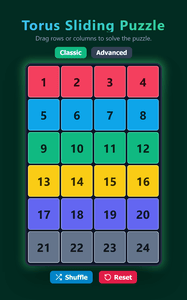
In this game, you slide rows and columns of tiles to place them in order from 1 to 24. You move a whole row/column with a single move and the tiles wrap around. It functions like a Rubik's cube mixed with the 15-puzzle.
I made a new puzzle game!
The game is played on a 4x6 grid of numbered and colored tiles. The objective is to put the numbers in a consecutive order, from 1 in the top-left to 24 at the bottom-right. Each row is color-coded to make it a bit clearer.
To start the game from a new shuffled state simply use the "Shuffle" button.
To make moves drag a tile horizontally or vertically, to move a whole row or a column. Drop to finish the move. Tiles will wrap-around.
Play
You can play the game in the frame below, or open it in a new tab. Press the "Shuffle" button to start.
Design and similar games
The game is designed to be a 2D version of a "Rubik's Cube", in a sense that you can't just move a single tile in isolation, but every move shifts an entire row or column. The tiles wrap around, as if the game was a 3D object and the bottom tiles were connected to the top tiles, while also left and right side were connected. If it were a 3D shape with these connections, it would need to be a donut (a torus).
The other design consideration was to make it easily controllable on a mobile screen. That's why I added the simple swipe or drag controls and made the game vertical.
Another similar game is a 15-puzzle where the goal is the same, put the numbers in a correct order. The moves are completely different though.
Connected tiles
I also added a second game mode, where there are connected tiles (blocks that span 2 tiles). These blocks force 2 rows or 2 columns to move simultaneously, adding additional constraints to your moves. Initially I found it more difficult than the former version, but after a bit of thinking and playing around with the board, I got it.
Difficulty
For a person who familiar with twisty mechanical puzzles this won't be very hard. However for someone who has never solved a 3x3 cube or something similar, it can pose a serious challenge.
Strategy
I like to solve the "classic" mode from top to bottom, starting with 1-2-3, then 5-6-7, 9-10-11, 13-14-15, 17-18-19, using the fourth column to move the tiles to their correct rows. Then I fill the fourth column, using the last row to reorder the tiles. This sometimes sometimes results in the solved state already, but other times the last row has a wrong order. If that is the case, I use the last row and column to do a swap.
Other ideas and considerations for developing the project further
A new control scheme
Another idea for a controls scheme is to make a 2 click move. The first click selects the tile, wnd the second click moves it to the desired location. With slick animations and clear selection and move indicators this would also work nicely.
Different blocks and board shapes
I would like to expand the game with variants played on bigger grids. Adding more tiles doesn't make this puzzle more complicated, but it would add more space for more connected tiles. Then I could add 1x3, 3x1, or a 2x2 blocks, or maybe even fill the whole board with different shapes. That would make for a unique puzzle.
Another game mechanic that could potentially be fun, is to make a tile that magnetizes on one of the edges to another tile, but doesn't if it is near the edge of the game board.
I would also like to try a non-rectangular game board, for example with an "L" shape. There are many shapes we could try and make a whole level progression system, with unlocking new levels of different shapes.
More mechanics and game modes.
Another idea: locked columns or rows. There could be rows that can't be moved horizontally or columns that can't be moved vertically.
Designed puzzles: there could be board layouts designed in a way there are for example 3 moves to win, and you need to find those moves, similar to a mate in 3 in chess.
Combinations of mechanics
All of those combined. There could be blocks with different shapes that you move on a "C" shaped board, but some of the columns are disabled. You need to use the shape of the board to disconnect a magnetized connected block tile to unlock specific moves...
Conclusion
As always, the more I add to the game, the more ideas I have for expanding it.